
Iwata
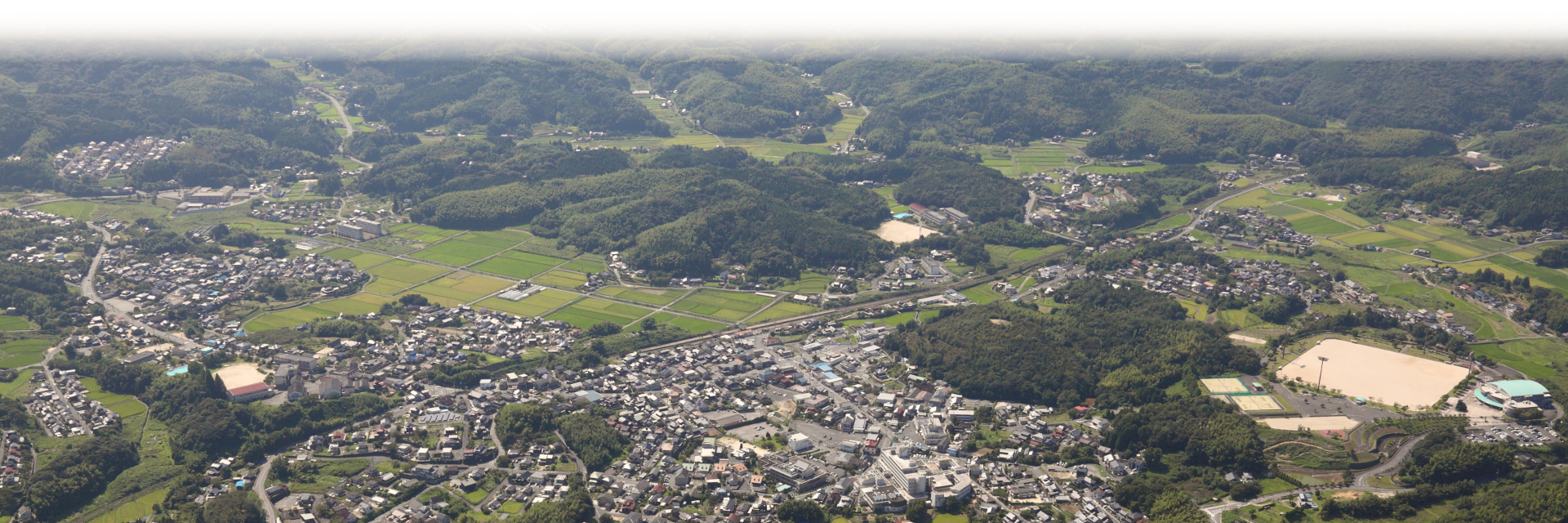
The Iwata area surrounding Iwato Hachimangū lies slightly inland from the Seto Inland Sea coast of Hikari City, Yamaguchi Prefecture, Japan. It lies within the basin of the Iwata River (the Mizoroi River), a tributary of the Shimada River.
The region is characterized by a relatively low-lying area where rice fields and farmland spread out, interspersed with gentle hills. Topographically, the area has been suited for settlement and agriculture, and historical records and archaeological remains suggest that human activity here dates back to ancient times.
1. Suō Koku Fudoki
A report that the domain instructed each village to submit in order to assess local conditions and restore finances during the Tenpō period (1830–1844)
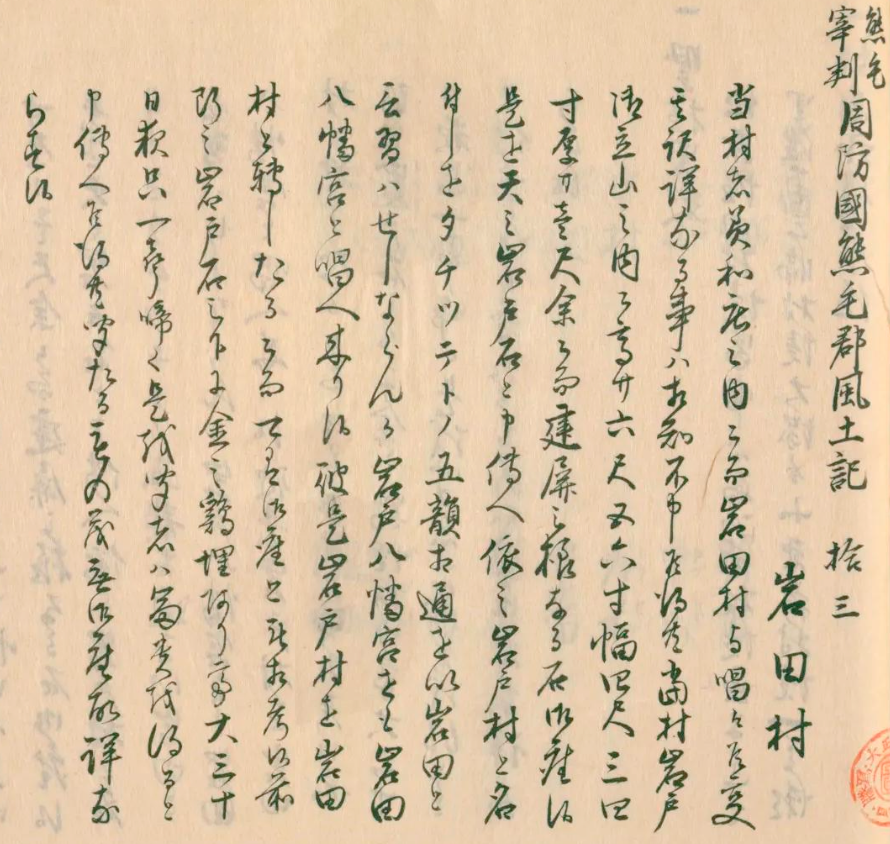
熊毛宰判 周防國熊毛郡風土記 拾三
岩田村
当村は美和庄之内ニ而岩田村と唱え候事
其訳詳なる事ハ相知不申候得共當村岩戸
御立山内ニ高サ六尺五六寸幅四尺三四
寸厚サ壱尺餘ニ而建屏之様なる石御座候
是を天之岩戸石と申傳ヘ依之岩戸村と名
付しをタチツテトノ五韻相通を以岩田と
言習ハせしならんか岩戸八幡宮をも岩田
八幡宮と唱ヘ来り候彼是岩戸村を岩田
村と傳したるニ而可有御座と被相考候前
断之岩戸石之下に金鶏埋ありて大三十
日夜只一聲啼く是を聞く者ハ富貴を得ると
申傳ヘ候得共聞たるもの茂無御座故詳な
らす候
The village lies within the territory of Miwa-shō and is known as Iwata Village.
The exact origin of this name is not clearly known.
However, within the sacred Mount Otate of Iwato in this village, there is a stone that stands upright like a
folding screen.
It measures approximately six shaku and five or six sun in height(about 2.0 meters), four shaku and three or four
sun in width(about 1.3 meters), and more than one shaku in thickness(about 30 centimeters).
This stone has been handed down as the Amano-Iwato Stone.
It is said that the village was originally called Iwato Village because of this stone, and that, through a
phonetic shift in which the sounds ta, chi, tsu, te, and to were considered interchangeable, the name came to be
pronounced and written as Iwata.
Likewise, Iwato Hachimangū has also long been referred to as Iwata Hachimangū.
For these reasons, it is thought that the name Iwato Village gradually came to be transmitted as Iwata Village.
It is further said that beneath the aforementioned Iwato Stone, a golden rooster is buried.
According to tradition, it cries out just once on the night of December 31, and whoever hears its call is said to
gain great wealth and prosperity.
However, as no one is known to have actually heard it, the details of this legend remain uncertain.
2. Iwashimizu Hachimangū Monjo
A collection of ancient documents preserved at Iwashimizu Hachimangū.
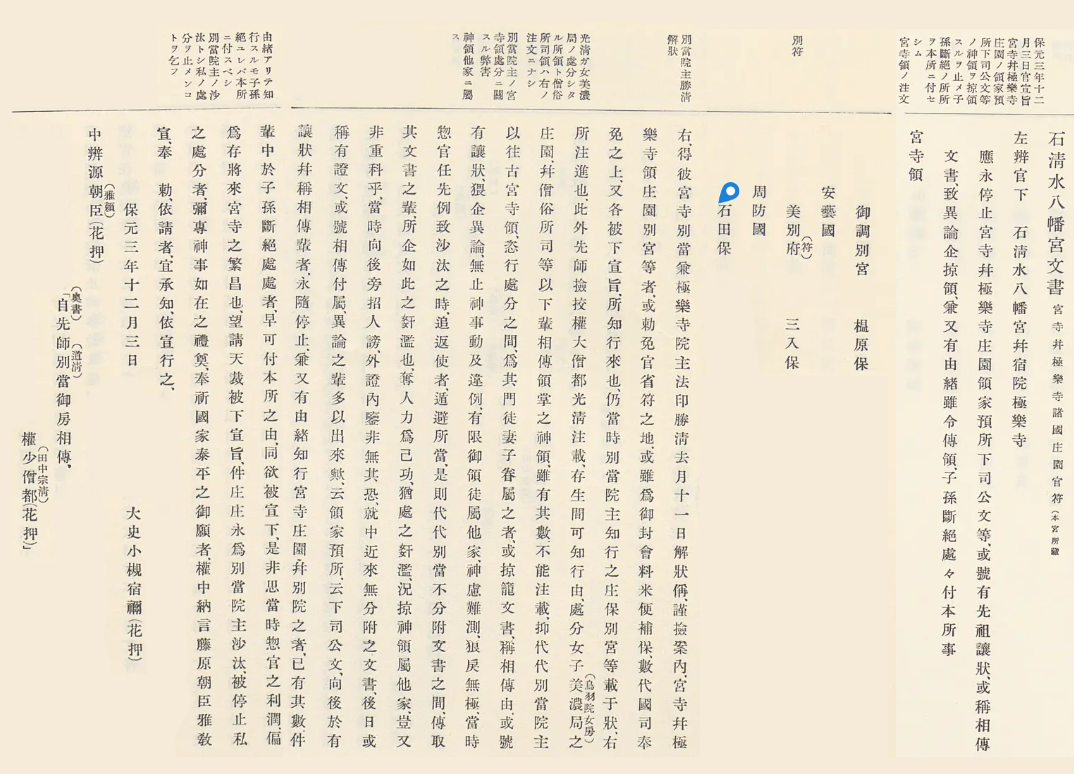
This is an official document issued by the Sabenkan, one of the administrative bureaus of the Dajōkan, on the third day of the twelfth month of Hōgen 3 (1159).
The document records the name of Daishi Ozuki no Sukune as the scribe, and Minamoto no Ason Masayori, who served as Middle Left Controller, as the issuing official (Daishi and Middle Left Controller being official titles). Finally, Tanaka Sōsei, Gon-shōsōzu of Iwashimizu Hachimangū, added a postscript stating that the document had been transmitted to him from the former Bettō, Dōsei.
— Modern Translation of the Original Text —
Order from the Office of the Left Grand Controllers (Sabenkan) to Iwashimizu Hachiman-gu and the Shukuin Gokuraku-ji Temple.
Regarding the Prohibition Issued in the Oei Era (1394–1428): Concerning the Proprietors (Ryoke), Custodians (Azukaridokoro), and Local Officials (Geshi and Kumon) of the manors belonging to the Temple-Shrine complex (Kuji) and Gokuraku-ji. It is hereby forbidden for such individuals to unlawfully seize territories by basely claiming to possess ancestral deeds of transfer or alleging hereditary ownership. Furthermore, in cases where lands were held by those with established lineage but the succession has since ended, such territories must be promptly returned to the Central Authority (Honjo, i.e., Iwashimizu Hachiman-gu).
The government temple estates Suo Province Iwata-ho. [Omitted below]
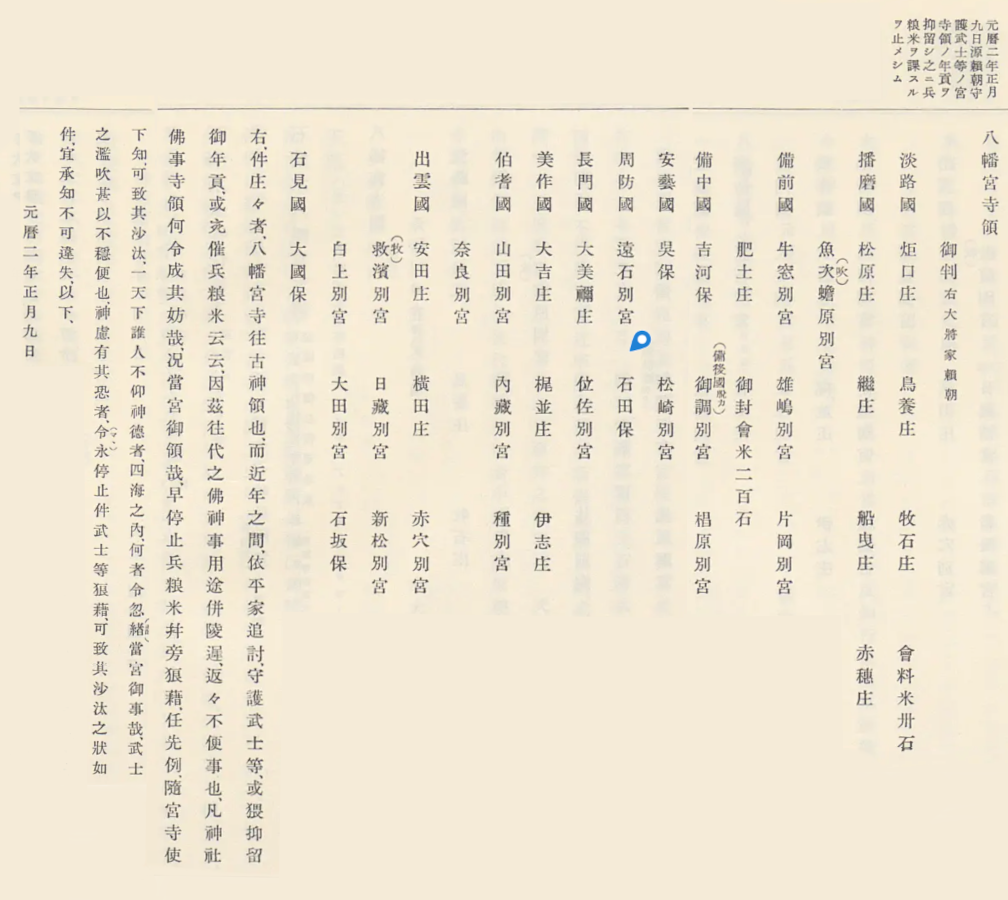
This document is a confirmation of land rights (ando-jo) issued by Minamoto no Yoritomo to Tanaka Yoshikiyo, the head abbot (betto) of Iwashimizu Hachiman-gu, in 1185 (the second year of the Genryaku era).
Written during the final stages of the Genpei War, it reflects Yoritomo’s efforts to establish his political legitimacy. Through this decree, he sought to protect the shrine’s ancient territories—held since the Heian period—from encroachment by local warriors, formally reaffirming the shrine's rightful ownership.
— Modern Translation of the Original Text —
Territories of the Hachiman-gu Temple-Shrine Complex Signature (Monogram) of Minamoto no Yoritomo
(List of Manors: omitted) Suo Province Toishi-Betsugu, Iwata-ho
The various manors listed above have been the sacred territories of Iwashimizu Hachiman-gu since ancient times. However, in recent years, taking advantage of the campaigns to subjugate the Taira clan, military governors (shugo) and warriors have reportedly been unlawfully withholding taxes or forcibly requisitioning them as military provisions (hyoro-mai). Consequently, the resources for long-standing Buddhist and Shinto rituals have been depleted, leading to the decline of these sacred rites—a situation that is truly deplorable.
In principle, no interference should be allowed regarding temple and shrine territories that support religious ceremonies, let alone the territories of this Great Shrine. You must immediately cease the requisitioning of military provisions and all forms of misconduct. Management of these lands must be conducted according to established precedents and under the direction of the shrine’s envoys.
Under heaven, there is no one who does not revere the divine virtues. Within the four seas, who would dare to neglect the affairs of this shrine? The reckless actions of the warriors are highly disturbing. If you fear offending the divine will, you must permanently stop the violence of these warriors and ensure the proper administration of these lands. Take heed of this command and do not fail to comply.
January 9, Genryaku 2 (1185)
3. Irie Monjo
Historical Documents Related to the Tawara Clan, Retainers of the Otomo Clan.
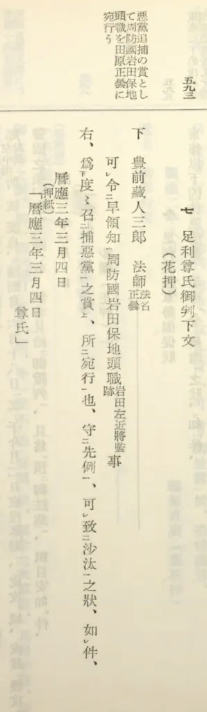
This official decree (kudashibumi) was issued in 1340 (the third year of the Ryakuo era) by Ashikaga Takauji to his retainer, Buzen Kurando Saburo (Tahara Naosada), granting him a reward of land.
During the turbulent Northern and Southern Courts period, Takauji maintained his military strength by seizing territories from enemies—such as Ishida-ho in Suo Province, formerly held by Iwata Sakon-no-shogen—and redistributing them among his meritorious warriors to secure their continued loyalty.
— Modern Translation of the Original Text —
Official Decree (Kudashibumi) with the Monogram (Kao) of Ashikaga Takauji
Subject: Command issued to Buzen Kurando Saburo (Lay Monk Name: Shodon)
You are hereby commanded to promptly take possession and management of the post of Land Steward (Jito-shiki) for Iwata-ho in Suo Province (modern-day Yamaguchi Prefecture), formerly held by Iwata Sakon-no-shogen.
Regarding the above, this territory is granted to you as a reward for your repeated service in capturing "brigands" (akuto, referring to enemy forces). You are to manage and administer this land in accordance with established precedents. Thus, this official decree is issued.
March 4, Ryakuo 3 (1340)